Cocaine!!!!

Is a drug and it is bad.

Now that we've gotten that straightened out.

Cocaine!!!!!!

We found the Coca museum.  I learned in Peru that sometimes when you ask someone (the concierge) if they know about a museum and they say no and then they tell you that it is probably closed anyway because it is Sunday, you should not listen to them.  We finally found it and it was Libre because it was Sunday...FREE.


The museum had some very interesting exhibits.  I didn't find out who sponsors the museum.  I wish I had.  You may wonder why have a Coca museum at all.  Basically, the story is this. Andean peoples in Peru, Bolivia, Colombia, Chile, Western Argentina and Ecuador have used the coca plant for ages.  To them, coca has great spiritual and cultural significance.


The leaves of the coca plant have been chewed by the Adean cultures for thousands of years.  The plant itself was considered sacred and many human sacrifices had their mouths stuffed with leaves before they died.  The museum had a very well preserved human sacrifice that was found with coca.  I though it tasteless to take a picture of it, since it was a human life at one point.  Obviously the picture below is not him.


Coca was also used medicinally.  It is a stimulant and as such will abate hunger and thirst.  The tea is used to help overcome altitude sickness.  If chewed it will cause numbness in the mouth and was used as an anesthetic.  It is also said to help digestion.


This is the goddess Koka.  According to lore, she appeared in the early days of the Inca Empire.  She had green skin and hair and almond colored eyes.  She was beautiful and all the men who knew her in the biblical sense(which apparently was a lot) were left sick with love for her.  She loved 'em and left 'em.  Some men killed themselves over their love pains.  This was something that the society was not going to be cool with.  The law enforcement went looking for her, but they too fell in love.

The Inca (which remember, we learned is the name for the ruling class of the Quechua people?) had the priests bring her to his court.  He too started to get a little woo hoo for her, but stood strong against her charms.  He had her killed and had her body parts buried in all different parts of the empire.  However, he still had a deep pining for her.

Shortly after her body parts were buried, a small plant grew.  It has leaves the shape of her eyes and was the color of her skin.  The priests brought the leaves to the Inca who chewed them and found his great desire for the goddess disappear.  He had them sent around the empire so that the other men could escape their pains too.


There is currently a bit of a fight happening internationally over the coca plant.  Colombia, with lots of American dollars fueling the project, is spraying coca crops with herbicides and pesticides.  It is a war against drugs thing.

In 1961 the UN held a convention where they decided that coca chewing needed to be done away with and that plants should be destroyed when grown "illegally".  They also declared it an illegal narcotic listing it with drugs like cocaine, opium, morphine and heroin.  In 1988 Peru and Bolivia tried to get the law amended stating the law “should take due account of traditional licit use, where there is historic evidence of such use.”  They were denied.  Bolivia continues to speak up about it.  Their current president is a former coca farmer.  He argues that farmers are not drug dealers and that denying farmers their livelihood is not right.  He is calling for their ancestral right to chew coca.

An important note to keep in mind, Coca farmers don't benefit that much from the drug trade.  They make very little for their effort.

Chewing coca leaves or drinking coca tea causes a mild stimulative effect and does not create any psychoactive or erratic behavior in the consumer.  It does not act in the body like cocaine does.  Because chewing coca is done with an acid (like quinoa ashes) to bring out the alkaloids, there are trace amounts of the cocaine alkaloid present in the bloodstream of the chewer.  It is no where near what you would find in a cocaine or crack user and the effects are very different. The coca leaf is no more cocaine than poppy seed muffins are opium. 


Coca is illegal in the US.  Interestingly enough though, there is one place in the US where coca is legal.  It is a plant in New Jersey and according to wikipedia, it produces cocaine for scientific study.

What's that now?

That's right friends.  Guess what else it produces?  An extract for Coca-Cola (cocaine free, of course) for that good old Coca-Cola flavor. According to the museum, they do it by using leaves that are already once used.  Like making a second batch of tea with the leaves from your first batch.

The museum was really cool and eye opening.  The only part that creeped me out was the plastic model of a man ODing in a bed.


And a tip of the hat to famous cocaine addicts.


They even had Whitney Houston up there.  They are quick to update the exhibits.


This is a great website about the coca battle.

Cacao!

In the guide book I was using, I read about a coca museum.  It sounded very interesting.  Supposedly it had a great exhibit on the coca plant and its importance to the Peruvian culture and the bastardization of the plant as cocaine.  It is supposed to be in San Blas, which was right behind our hotel somewhere(which also meant uphill again).  However when we looked at the map we got a little confused and we went the opposite direction.  Good thing, because instead we found the cacao museum!  Qué Suerte!


Theobroma Cacao: Theobroma coming from the Greek and meaning food of the Gods and Kakaw which was the Maya word for the bean.


Cacao contains Dopamine, Serotonin and Theobromine which are all mood enhancers.  It also houses good amounts of magnesium, a mineral in which most Americans are deficient.


The museum had some great information on where chocolate came from and how it reached Europe becoming a good demanded world wide.


Cacao beans grow in pods on trees.  They are surrounded by a white pulp which is removed and can be eaten.  The beans are then either piled up or put on trays and covered in banana leaves and left to ferment.  After fermentation they are spread out and left to dry in the sun.  After that it is off to exportation!


At the museum you can roast your own beans and make truffles.  You can also buy roasted cacao bean shells to be used for tea. 

I did and it is delicious. 

The way the Maya, Aztec and Inca drank cacao was by grinding the beans with stones.  Once the beans formed a paste, they would mix it with spices and water.  Then they would pour the mixture, back and forth, from one cup to another to create a froth.


Interesting to you perhaps, is the fact that the Inca even had access to cacao.  Cacao is from Mexico; it started its rise to popularity in the Yucatan Peninsula. 

Archeologists may have found proof that cacao existed in Honduras as far back as 1100 AD.  They found pottery with traces of theobromine and caffeine in them and speculate they were vessels used for cacao consumption.

Cacao was integral to Mayan and later Aztec culture.  It was not native to Peru.  Which means that the Inca imported the cacao from the Yucatan or possibly even Honduras.  Can you imagine that trip?  Neither can Google maps.  I tried to see how long it would take to walk from Cuzco to Tegucigalpa and Google couldn't calculate it.  Crazy!

Cacao was valuable enough to both the Maya, Inca and Aztec to be used as currency.  You could buy lots of things with it including prostitutes.

Some interesting differences between the Inca and Maya:
*The Maya never had a central capital nor leader.  Each city ruled itself.  The Inca capital was Cuzco and it had many emperors in succession.  Inca is actually the name for the ruling class of the Quechua, which were the people.
*The Maya had a written language, the Inca did not.
*The Inca Empire lasted only a hundred years ending with the  arrival and subsequent take-over of the Spanish.  The Maya Civilization lasted thousands of years and sort of just slipped out of being after the arrival of the Spanish.  Maya descendants still exist and still speak the original language.

Sacsayhuamán

Along with meeting Jesusia, we lunched at Los Perros Wine and Couch Bar.  And it was just as advertised, wine and couches were everywhere to be had!


Instead of wine, we opted for pisco sours.  Delicious!  We ordered the curried pumpkin soup, yuca fries, and salad platter.  Everything was super yummy.

I would like to take this opportunity to tell you about traditional Peruvian cuisine and why I didn't eat much of it.  The potato is from Peru.  I had plenty of those.  The tomato is from Peru.  The corn in Peru has humongous kernels.  The avocado is from Peru.  Maca is from Peru (and I consume quite a bit of that at home).  Also from Peru though...

I did not partake in the baked Guinea pig, nor the Alpaca.  I'm sorry if I've disappointed, but baked guinea pig looks and smells just like it sounds.  And I can't make the leap from pet store to plate (also I'm vegetarian, that is the bigger reason).

So where, you ask, does one eat if they too do not like baked guinea pig, yet do not desire to sit on couches while they eat?  Never fear, you can dine at the McDonald's, KFC or Starbucks in the Plaza de Armas.


The far reaching arm of the capitalist, consumerist west is conquering its way south.  I tremble in anticipation for the day we open a Burger King on Easter Island.  The Spanish Imperialists of the 16th century would be proud.

With our bellies full and happy, we made our way uphill(again) to Sacsayhuamán.  (Pronounced sort of like Sexy Woman).   On our way there, we met this woman.  This photo cost me $20 Nuevo Sol.


Sacsayhuamán was a hilltop fortress and may have been the site of a sun temple(Sacsayhuamán means House of the Sun).  It has a large amphitheater type area which was probably used for rituals and ceremonies and is now used for the Inti Raymi or winter solstice celebration.  The structure is an incredible piece of engineering ingenuity.  The stones are massive and perfectly fitted together.   It was built by Inca citizens, all were required to work a certain amount of time in public works.

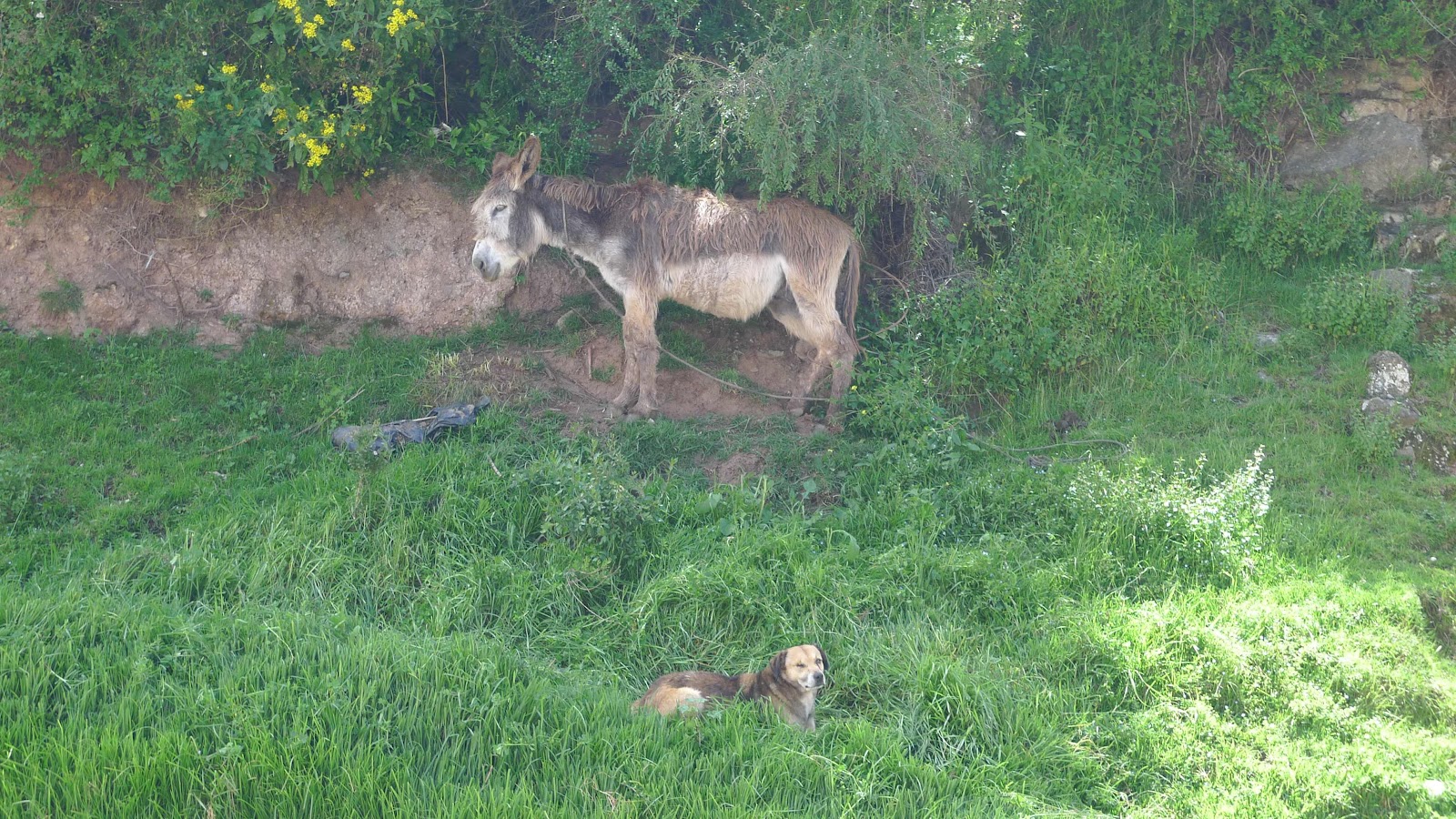
Perro y Burro a Sacsayhuamán.

Sacsayhuamán was the site of a battle between the Spanish and Manco Inca (I mentioned him previously).  The Inca rebellion managed to stave off the Spanish for a few nights, but were thwarted by a surprise attack in the dark of night.  During the battle some 1500 Inca warriors were killed.  Lore says that many of them chose to jump to their deaths from the high walls rather than succumb to the Spanish.  Francisco Pizzaro's brother was also killed in the fight. (Francisco Pizzaro is the man who conquered Peru for Spain).  This battle at Sacsayhuamán is honored on Cuzco's coat of arms.

http://www.ngw.nl/int/peru/cuzco.htm

Much like all the other cool archeological wonders of the world, this one was harvested for parts.  It essentially became a large quarry.  Rocks for the taking until the early 1900's.


The fortress was built with three zig zag tiers.  Each one represents a sacred animal; the Condor, the Puma and the Snake.  The city of Cuzco itself is said to have been built in the shape of the Puma, with Sacsayhuamán as its head.

Also, it has a great view of the city and its altitude is about 12,000ft.  Yipes!

Also it is for lovers.


Cuzco

When we got into Cuzco, it was 8am.  We had been traveling all night.  Neither one of us had gotten much sleep.  So, we did what any exhausted individuals would do...

We went exploring.

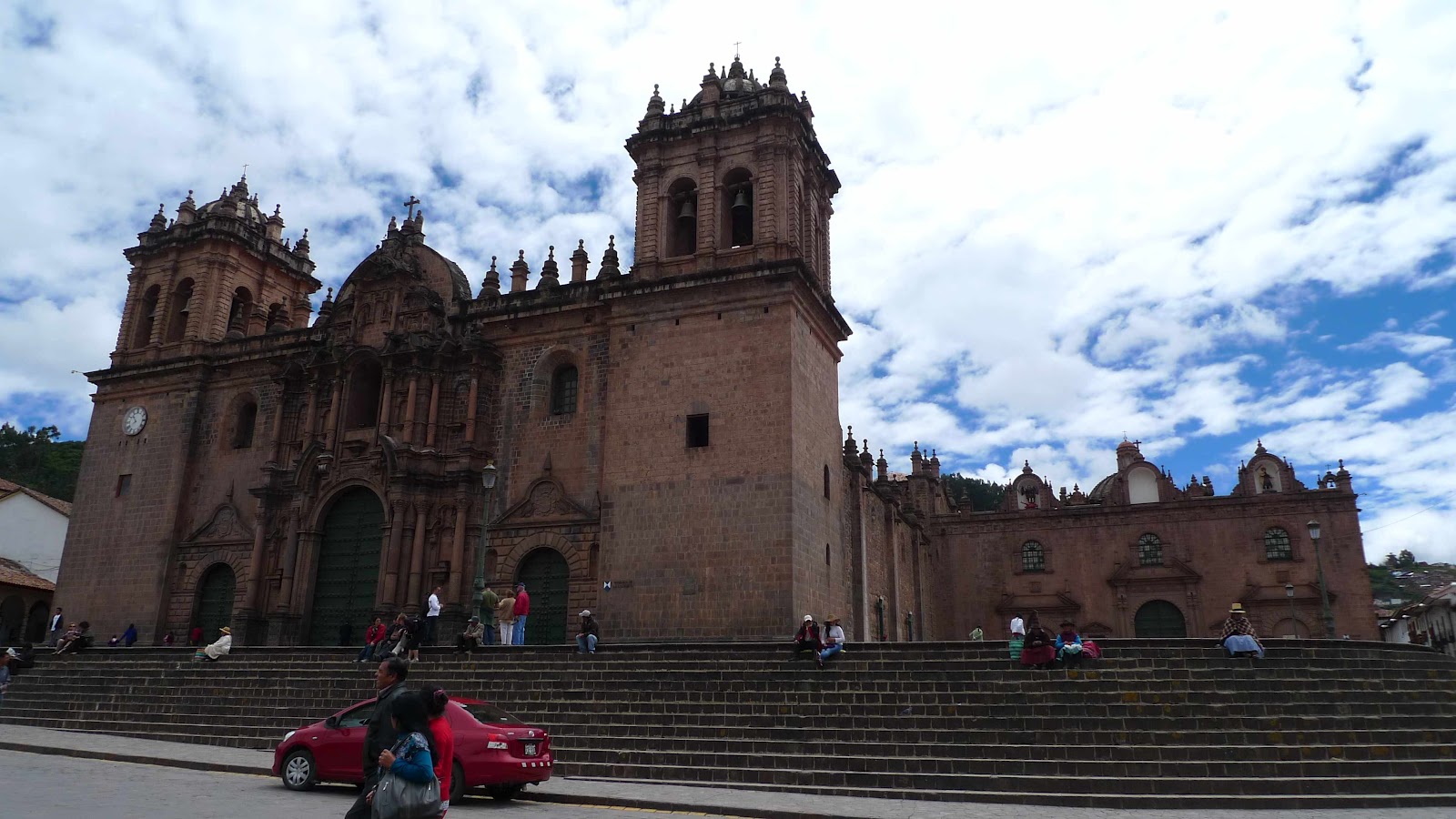
First thing we found was the Plaza de Armas.  It is the former site of the Palaces of Inca Huyana Cápac and Inca Viracocha.  The Plaza de Armas is now the site of the Iglesia de Compañía and the Catedral.  Also, it is a plaza, so people like to hang out there.


The Catedral was built first.


It was built to celebrate the Spaniards victory over Manco Inca.  Manco Inca had been fighting over the empire with a half brother (Atahualpa) from Quito when the Spanish arrived.  The Spanish army killed Atahualpa and marched into Cuzco as heroes.  Manco later realized they were no such things and fled Cuzco to amass an army to fight the Spanish.  Unfortunately, he did not win.

 The Iglesia was built in the following century by the Jesuits.


After the Plaza de Armas, we wandered.  Cuzco is very hilly.  The Incas really seemd to like putting walls and stairs and roads on hills.   There is a lot of Inca infrastructure still in Cuzco.  A lot of the stone roads in these photos were built by the Incas. 

In 1950 an earthquake struck Cuzco destroying nearly 63% of the buildings.  Nearly all of which were constructed after the Spanish conquest.  Incan foundations, doorways, walls, etc all still stood.  Very little of the Inca built structures were even affected by the earthquake.  Really, truly amazing!

The stones on the bottom are Inca walls that have stood for hundreds of years.  The adobe on top is new construction. Bottom photo is an Inca stairway.  Crazy.


Amazing to see, but still hard to hike uphill all day at 11,000 ft.  Just saying.  My heart felt like exploding many times.


I met a woman named Jesusia who sells hand made goods on the stairs outside her home.  She was pretty awesome, and despite my sad excuse of 3 years high school Spanish and her not speaking any English, we were able to communicate.  I guess money really does talk, in any language.  I bought some really great stuff, for very cheap.


I got a hat, some socks, two pairs of gloves, two baby sweaters, a poncho and a hat for my aunt (not pictured) all for 145 Nuevo Sol.  Which equals about $55 US.  So...not a bad deal.


She also threw these guys in for free.


The Nuevo Sol is really in pretty good shape.  It has been in use since the early nineties and has managed to remain fairly stable against the dollar, tending to fall somewhere between 2.5-3.5 against our 1.  It is also one of the few South American currencies that saw little affect from the weakening dollar.  I say, well done Peru.

Mas Luego.